Brush removal / The Wildwood Journal
Forestry mulching vs. brush hogging: what does your land need?
Compare forestry mulching and brush hogging by vegetation, finished surface, and maintenance needs. Learn what to send for a useful clearing estimate.
Brush hogging usually means rotary cutting for grass, weeds, and brush within the cutter’s rated capacity. Forestry mulching processes woody vegetation into mulch and is worth considering for denser reclamation work. Their capabilities overlap. Choose around the growth, access, and finished condition you need, rather than treating either method as the answer to every overgrown property.
An open field that has missed a season of mowing is a different job from a field edge overtaken by saplings. Both can look like “brush clearing” from the road, but they may need different equipment and a different plan for the material left behind.
For property owners in Southern Illinois and Western Kentucky, the useful question is what must happen between the land’s current condition and the way you want to use it. Here is how to compare the options before requesting an estimate.
What do brush hogging and forestry mulching mean?
People commonly use brush hogging or bush hogging to describe cutting vegetation with a rotary cutter. Bush Hog is also an equipment brand. The job description should identify the actual machine and attachment, because a light cutter and a heavy-duty cutter do not have identical capabilities.
Forestry mulching refers to processing unwanted vegetation into mulch. Bobcat’s attachment guidance describes drum mulchers for turning trees and overgrowth into mulch, while its rotary cutters handle grass, brush, and some small woody growth. That overlap is why the attachment’s rating matters more than the service label alone.
Further reading: Bobcat: drum mulchers and rotary cutters
When might rotary cutting fit the job?
Rotary cutting is worth discussing for established open areas where the main task is managing tall grass, weeds, and brush that the selected cutter is designed to handle. A field with known access and a routine maintenance history presents a different starting point from unfamiliar ground hidden by years of growth.
There is no universal brush-size limit for this category. For example, Bush Hog lists up to 1-inch brush for its Razorback series and up to 3½-inch brush for its 2215 model. Those are manufacturer examples, not specifications for Wildwood Forge’s equipment or a promise that either machine fits your property.
Further reading: Bush Hog: Razorback series specifications · Bush Hog: 2215 rotary cutter specifications
When should you consider forestry mulching?
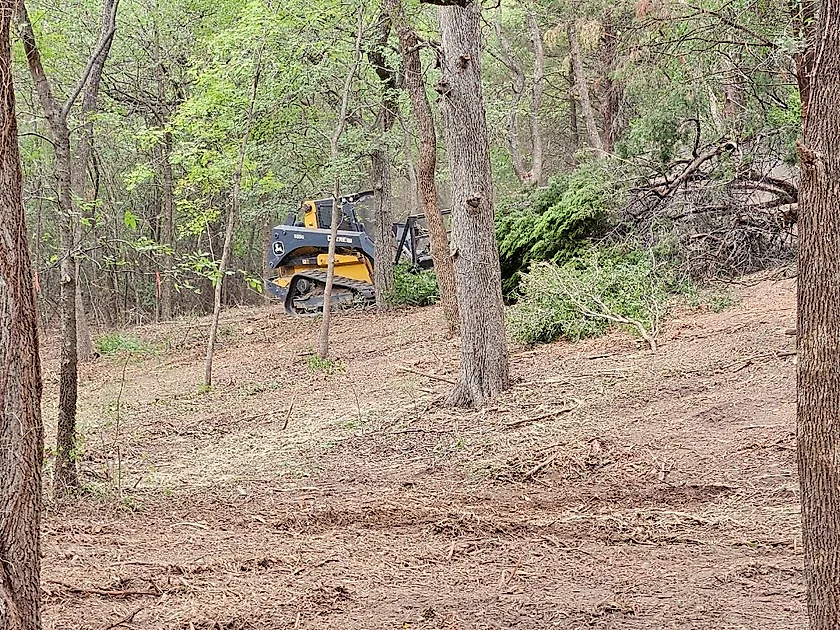
Discuss forestry mulching when woody growth and the way it will be processed are central to the project. Examples to evaluate include opening an overgrown access route, reclaiming brushy edges, or reducing unwanted understory while identifying trees that should stay. Each still needs an assessment of the actual vegetation and ground.
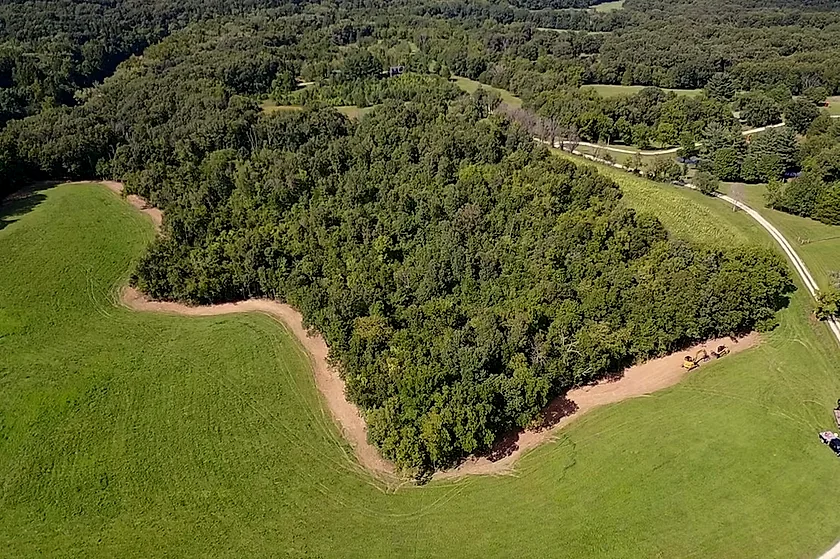
Consider a property with a grassy center and a dense wooded boundary. It may make sense to discuss those as separate work areas instead of requesting one treatment across the whole parcel. The aerial Mayfield photograph above is a useful visual reference for that conversation: open ground and wooded edges can sit directly beside each other.
That photograph shows a Wildwood Forge project; it does not establish which attachment should be used on your land. Describe your goal and let the proposed scope explain the method.
| Your starting point | What to discuss |
|---|---|
| Established open area with grass and weeds | A suitable cutting and maintenance approach |
| Dense woody growth or overgrown access | Whether forestry mulching fits the vegetation and desired finish |
| Grass, saplings, and retained trees together | Separate work zones and a selective clearing plan |
| Roots, large obstacles, or future construction | Additional scope beyond vegetation cutting |
What will the ground look like afterward?
Ask what happens to the cut material and what remains above ground. “Cleared” can mean an area is accessible, that unwanted stems are reduced, or that a particular finish has been achieved. Put your expectation into the estimate so you and the contractor are describing the same result.
Do not assume either label includes root excavation, stump removal, debris hauling, or a surface ready for an ordinary lawn mower. If your next step depends on one of those conditions, discuss it explicitly. A trail you plan to walk, a field you intend to maintain, and a future building area have different handoff requirements.
Also discuss follow-up care. An initial clearing project and the later work needed to keep an area usable are separate decisions. Ask what the finished surface allows and how to recognize when another maintenance visit should be considered.
Is brush hogging cheaper than forestry mulching?
A service name is not enough to compare prices. Ask for estimates covering the same boundaries, vegetation, retained features, material handling, and finished condition. A quote for cutting an open area cannot be compared fairly with one that includes reclaiming its densely overgrown edges.
If budget is the main constraint, explain which area matters most. You might prioritize access to a gate or one usable section before discussing the rest. Wildwood Forge provides a free estimate based on the property and requested work; this guide does not substitute a generic per-acre price for that assessment.
What should you send when requesting an estimate?
Send your city and county, a marked map of the work area, and photographs that show both the overall growth and representative stems. Include the entrance and any known obstacles. Photos help start the conversation, while the condition of the site determines what can be confirmed in the final scope.
Wildwood Forge offers forestry mulching and brush removal across Southern Illinois and Western Kentucky. You do not need to choose an attachment before contacting us. Tell us what you want to reach, maintain, or reclaim, and we can discuss an approach around that goal.
- Which areas need work, and which trees or screens should remain?
- How will you use the ground after clearing?
- Are there known fences, wire, rocks, drainage features, or other obstacles?
- What finish and material handling do you expect?
- Which area is the priority if the project is completed in stages?